
- Corsica
A guide to Corsica's history
Corsica is an island with a turbulent and fascinating past. Most famous as Napoléon Bonaparte’s birthplace, its strategic position has meant invasion and resistance have been recurring themes in the island’s history.
A rich history in Corsica
Corsica’s location has a large part to play in its rich history. An island in the Mediterranean Sea, sitting to the south east of France and to the west of Italy. Corsica has a rich history, of which locals are extremely proud.
The earliest Corsican inhabitants date from around 3000BC; they left impressive menhirs or standing stones, carved with staring faces, which can still be seen at Filitosa. Centuries later, in 540 BC, the Greeks colonised the island; they were succeeded by the Romans, and it was then that the pattern of conflict and battle began with waves of invaders and raiders to the shores.
The island suffered under harsh rule by successive Mediterranean kingdoms, with Genoa gaining undisputed control from around 1500. Genoa sought French help when rebellion flared in 1729 and French troops pacified the island. The rebellion continued, however, and in 1755 the Corsican patriot Pascal Paoli was proclaimed General of the Corsican Nation. Before being forced out by the French in 1769, Paoli founded a university, and introduced a democratic constitution, with all men over 25 eligible to vote.
Paoli returned in 1790 and, with British backing, declared independence from France; Nelson lost his eye at the siege of Calvi and British forces captured a number of coastal towns. Independence was short-lived though; the British withdrew in 1796, Paoli departed to live in London and Napoléon (who was born in Ajaccio) moved in his army. Corsica has been a department of France ever since.
A background of Corsica
Compared with mainland France, Corsica is very sparsely populated. None of the towns on the island is large; even the capital of Corsica, Ajaccio, has a population of only 65,000. Corsican families retain close links to their land, which is the main reason why the island has escaped mass exploitation despite some recent building; many people will never sell their inheritance for development.
Corsicans are proud of their heritage. Mainland France is referred to as ‘le continent’ and attempts by outsiders to make a fast buck out of the island are resented. Nationalist sentiment is rooted in a deep personal love for Corsica and is expressed, at different levels, through the teaching of Corsican language (Corsu) in schools, or through daubing FLNC (Front de la Libération Nationale de la Corse) slogans on public signs and buildings.
Many Corsicans of all ages speak Corsican, a language whose history is obscure. Written, it looks rather like Italian, though it sounds different to the ear. Many names are Italian in form, with some pronounced the Italian way, some the French way. Corsican music is also resurgent; in recent years musicians have fused modern melodies with traditional vernacular songs or church chants to create an evocative, contemporary folk music.
The Moor's Head
The Moor’s Head has become Corsica’s emblem and appears on flags throughout the island. Locally produced goods, official buildings, Corsican-owned boats, properties, and aircraft carry this symbol, and all Corsican political parties (whatever the strength of their Nationalist tendencies) also use the emblem. In some specific cases it may represent a stronger Nationalist/Autonomist leaning, but is generally a simple statement of pride in their island.
The symbol dates back to the 13th century, when the Aragonese were given rights over Corsica by the Pope after their victory over the Saracens. They portrayed their acquisition by the Moor’s Head. It was however, forgotten in Corsica during the subsequent Genoese occupation when the Virgin Mary (the patron Saint of Corsica) was used to symbolise Corsica.
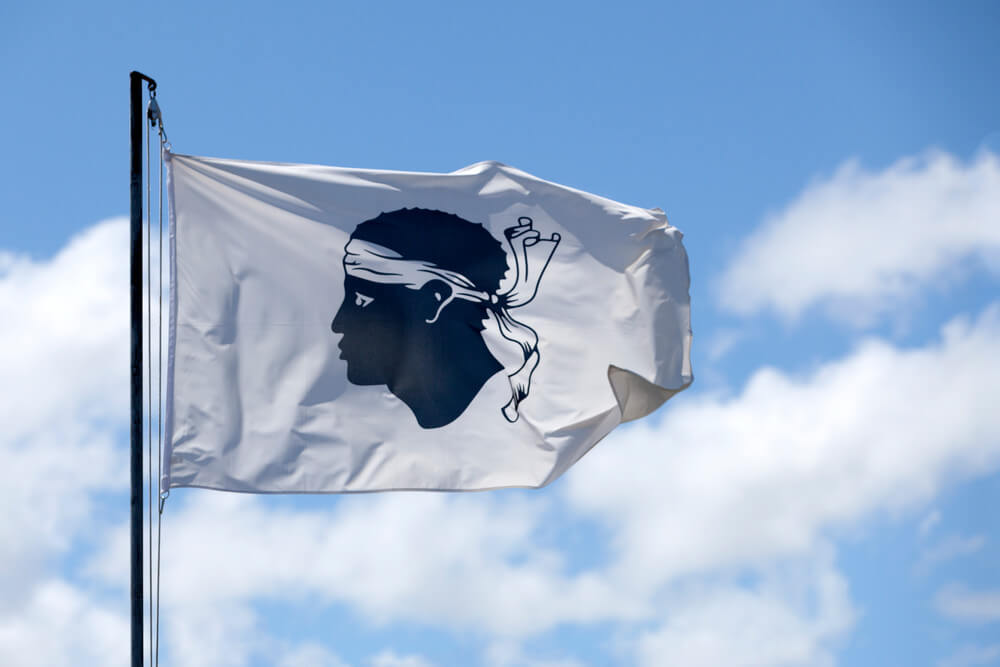
The Corsican flag
Behind the Corsican flag, there is much history. It is a rather identifiable flag and quite different to others in Europe, with a white background and a black face in profile.
In the 18th century, the German adventurer, Theodor Von Neuhof (who became king of Corsica for six months in 1736), chose the forgotten Moor’s Head as the National flag. Twenty years later, it was re-established as the official Corsican flag by the great Corsican patriot, Pascal Paoli, who insisted that the bandana was moved from its original position covering the eyes (to the forehead) to symbolise the liberation of Corsica.
Is Corsica in France?
Corsica is just off the coast of France, and people often think Corsica is part of Italy due to its proximity to Sardinia.
You may wonder: Is Corsica French? The answer is yes: Corsica is part of France, and the people who reside in Corsica are considered French.
However, Corsican culture is strong and unique, with many traditions and festivities that can only be enjoyed on the island. Corsican food and even the language are strongly identifiable, making it a wonderfully unique holiday destination.

- Contact Details
We are here to help
Need help planning your perfect holiday? With just a simple phone call, you will be connected to someone who knows Corsica like the back of their hand. Speak to us today for an unforgettable holiday.
New bookings
Sales office opening hours
Monday to Friday: 9am to 7pm
Saturday: 9am to 5pm
Sunday: 10am to 4pm
Existing bookings
Aftersales opening hours
Monday to Thursday: 9am to 5.30pm
Friday: 9am to 5pm
Saturday & Sunday: Closed